
CPTED Assessments for Multifamily, Commercial, and HOA Properties
Tricorn Assessment Group conducts Crime Prevention Through Environmental Design evaluations performed by a Florida Crime Prevention Through Environmental Design Practitioner (FCP). Each assessment documents lighting, visibility, access control, and environmental conditions that affect crime risk, and produces a written report structured to support premises liability defense and Florida Statute 768.0706 compliance where applicable.
.avif)
What is CPTED?
Crime Prevention Through Environmental Design (CPTED) is a method used to reduce crime by improving how properties are designed and managed. For multifamily properties, these conditions can affect how easily residents and visitors can observe activity, how people move through the property, and whether certain areas create concealment opportunities or uncontrolled access.
A CPTED assessment evaluates these conditions and identifies opportunities to improve safety through practical changes to property design and management practices. Our assessments are conducted by FCP-certified practitioners holding the Florida Crime Prevention Through Environmental Design Practitioner designation required under Florida Statute 768.0706.
A professional CPTED assessment identifies these conditions before an incident occurs, documents them in a format usable by insurance carriers and legal counsel, and provides a practical roadmap for property improvements.

Who is qualified to perform the CPTED assessment?
Every Tricorn CPTED assessment is conducted by a Florida Crime Prevention Through Environmental Design Practitioner (FCP) designated by the Florida Crime Prevention Training Institute.
The FCP credential is the qualification required under Florida Statute 768 0706 for multifamily properties seeking the presumption against liability. Outside Florida, it signals that your assessment is being performed by a practitioner trained to national CPTED standards rather than a general security consultant or facilities inspector. This distinction matters in litigation. Assessments conducted by unqualified parties are routinely challenged by opposing counsel in premises liability cases. A report authored by a credentialed practitioner carries weight that a generic security audit does not.
Every Tricorn assessment is conducted by an FCP-certified practitioner with real-world security and operational experience. Our team includes Mario deGraaf (FCP, CPD) with 17+ years military intelligence experience and hundreds of completed assessments, Kyle Scroggins (FCP) with 14+ years in multifamily security, Robert Gaskell (FCP), a U.S. Air Force veteran with 100+ assessments completed, and Seth Ryan (FCP), a U.S. Army Special Operations Ranger and former law enforcement officer. Meet the full team.
Four strategies for safer properties
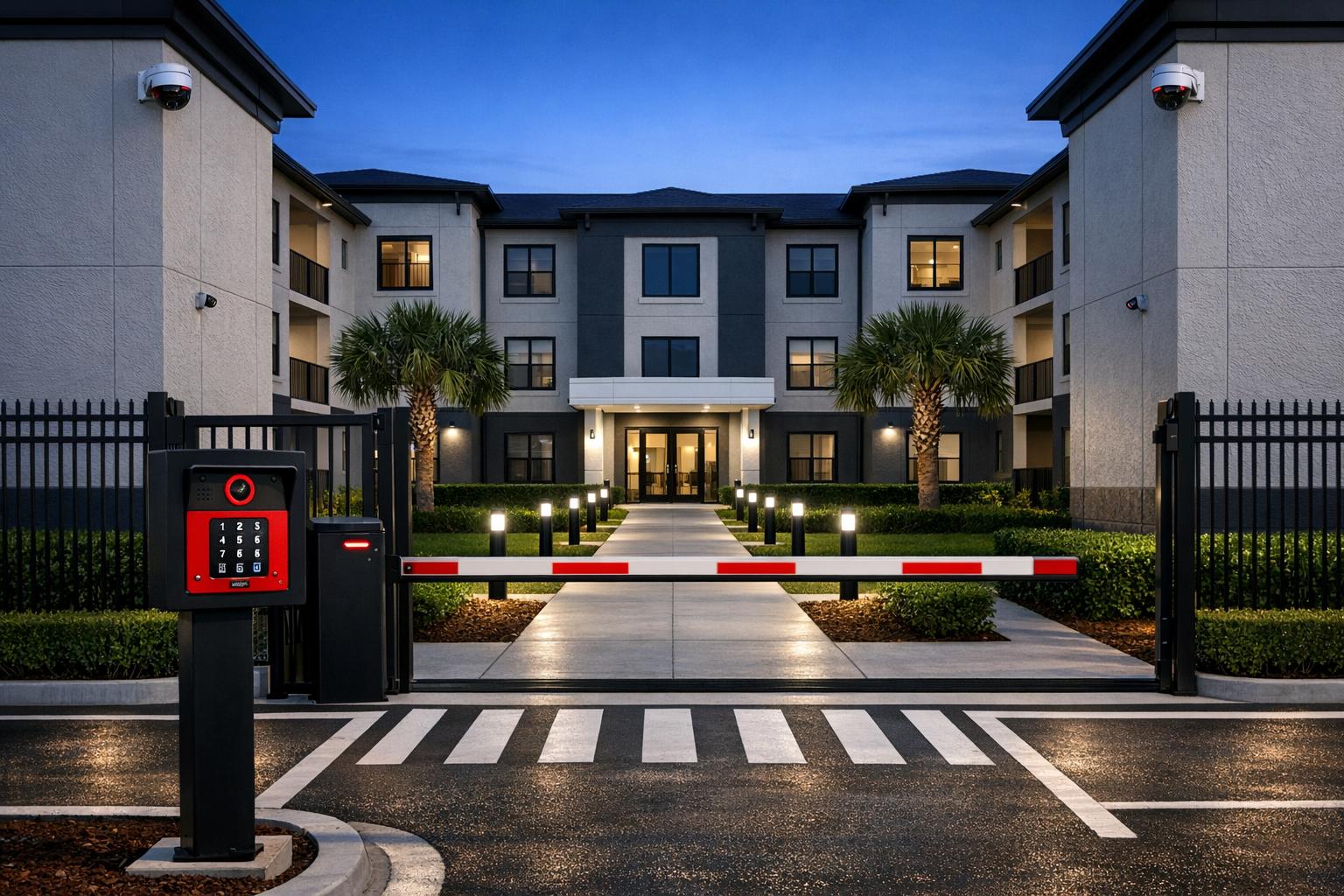
CPTED uses four core principles to reduce opportunities for crime. These principles focus on visibility, access control, clear ownership of space, and ongoing property maintenance. They are widely used when evaluating multifamily housing and residential communities.
Natural Surveillance
Natural surveillance improves visibility across the property so residents and staff can observe activity. Clear sightlines around buildings, walkways, and parking areas reduce opportunities for concealment and increase awareness.
Lighting, landscaping, and building orientation all influence how easily people can see activity throughout the property.
Natural Access Control
Natural access control guides how people enter and move through a property. Clearly defined entrances, pathways, and access points discourage unauthorized entry while maintaining usability for residents and visitors.
Design elements such as pathways, transition areas, and wayfinding help direct movement across the property.
Territorial Reinforcement
Territorial reinforcement creates a clear sense of ownership and responsibility within the property. When residents and visitors can easily distinguish between public and private spaces, expectations for behavior become clearer.
Lighting, signage, and clearly defined entrances help reinforce property boundaries.
Maintenance and Social Management
Maintenance and social management focus on the ongoing care of the property and community ownership. Well maintained lighting, landscaping, and buildings signal that the property is actively managed and discourage disorder.
Consistent maintenance helps support long term safety and reinforces the other CPTED principles.
CPTED Assessments and Florida Statute 768.0706 Compliance
Florida HB 837 (Florida Statute 768.0706) requires owners of multifamily residential properties with five or more units to have a documented CPTED assessment conducted by a Florida Crime Prevention Through Environmental Design Practitioner (FCP). Properties that complete and maintain a compliant assessment receive a presumption against liability for third-party crimes on the premises.
Tricorn assessors hold the FCP designation required under Florida Statute 768.0706(2b). Every assessment Tricorn conducts is documented to withstand legal scrutiny and support a property owner's presumption against liability in the event of a negligent security claim.
Documented assessments must be reviewed every three years. Properties that miss the reassessment window lose their compliance status and the liability protection that comes with it.
Is Your Property Designed to Reduce Crime Risk?
Identify security risks before they become problems.
Who Needs a CPTED Assessment

Property Managers
Document compliance, protect your residents, and demonstrate proactive risk management to ownership, insurance carriers, and legal counsel. CPTED assessments identify lighting, access, and visibility issues before they become incidents.
Real Estate Acquisition
Conduct a CPTED evaluation during due diligence to assess security conditions and 768 0706 compliance status before closing on a multifamily target.
Property Owners
Reduce liability exposure across your portfolio and document substantial compliance with Florida Statute 768 0706 to protect the presumption against liability in negligent security cases.
Real Estate Developers
Integrate CPTED principles into new multifamily developments and major renovations to meet 768 0706 requirements from day one and avoid costly retrofits.
Asset Managers
Evaluate CPTED compliance and security risk across a portfolio of residential properties to manage insurance terms, capital planning, and liability exposure.
Our Review Process
Property and Crime Context Review
Before the on-site visit, we conduct a documented review of the property and surrounding area. This includes analyzing calls for service data, reported incidents, neighborhood crime patterns, and prior security documentation. The crime data analysis directs our assessor's attention to the specific incident types and property locations presenting the highest risk, and produces a documented baseline included in the final report that demonstrates the property owner's awareness of local crime conditions.
On Site Assessment
Our assessor conducts a detailed review of the property including parking areas, entrances, walkways, landscaping, lighting, and common spaces. The goal is to identify environmental conditions that may increase offender concealment, limit visibility, or weaken access control.
Nighttime Observation
Nighttime conditions are evaluated to determine whether lighting and visibility support safe observation of the property after dark. Parking areas, building entrances, and common spaces are reviewed to identify shadow areas or lighting deficiencies.
Assessment Report and Presentation
After the assessment is completed, you receive access to the results through a secure report link along with a downloadable PDF report. The report includes documented observations and considerations for improvements.
Our assessor then meets with you to review the findings and discuss considerations that may improve property safety and reduce potential security risks.
Meet Our Assessors
Every Tricorn assessment is conducted by an FCP-certified practitioner with real-world security and operational experience. Our team includes Mario deGraaf (FCP, CPD) with 17+ years military intelligence experience and hundreds of completed assessments, Kyle Scroggins (FCP) with 14+ years in multifamily security, Robert Gaskell (FCP), a U.S. Air Force veteran with 100+ assessments completed, and Seth Ryan (FCP), a U.S. Army Special Operations Ranger and former law enforcement officer. Meet the full team.
Locations We Serve for CPTED Assessments
Tricorn provides CPTED assessments for multifamily and commercial properties across Florida and nationally. Service areas include the cities below.






Request a Free CPTED Assessment for Your Property
Contact Tricorn to discuss a CPTED assessment for your multifamily, commercial, or residential property. We help identify security risks, improve property safety, and support compliance with Florida Statute 768.0706.
Why Property managers choose Tricorn
Prefer to reach us directly
Frequently Asked Questions
The duration depends on the size and layout of the property. Most multifamily CPTED assessments include a daytime inspection, a nighttime lighting review, and preparation of a written report.
You can contact us to request an estimate for your property.
After the assessment is completed, clients receive a detailed report outlining observed conditions and recommended improvements. The report is delivered digitally and typically includes supporting photographs and documentation of security concerns identified during the evaluation.
Yes. Lighting conditions are an important part of CPTED assessments. The evaluation reviews illumination levels, shadow areas, and visibility conditions in parking areas, walkways, entrances, and other shared spaces.
Yes. In Florida, a documented CPTED assessment conducted by an FCP-certified practitioner is required under Florida Statute 768.0706 for multifamily property owners to receive the presumption against liability for third-party crimes. This presumption shifts the burden of proof to the plaintiff in a negligent security claim and can support a motion for summary judgment. A properly documented assessment is your primary legal defense against premises liability exposure.
Yes. After completing the assessment, clients receive a written report and secure web link documenting observations, photographs, and recommended considerations. A Tricorn assessor also reviews the report with the client to discuss findings and recommended next steps.
A CPTED assessment evaluates how property design and environmental conditions affect crime risk. It focuses on visibility, access control, territorial definition, and maintenance as crime-prevention mechanisms. A general security audit typically focuses on the performance of security systems such as cameras, alarms, and access control technology. CPTED is often performed before hardware decisions are made and can reduce the need for expensive technology by improving the environment itself.
No. A CPTED assessment evaluates how property design, lighting, and access control can reduce crime opportunities, but it does not replace security personnel. CPTED principles and security staffing serve different functions. CPTED improves the physical environment so that natural surveillance, clear sightlines, and controlled access points make it easier for security officers to monitor the property effectively. Properties that combine CPTED improvements with trained security staff typically achieve stronger results than either approach alone. The assessment report may include considerations about how security staffing and environmental design can work together to address specific risks identified during the evaluation.
Other Services We Provide

Security Lighting Assessments


Security Vulnerability Assessments

Florida Statute 768.0706 Compliance




.avif)






.webp)