Florida Statute 768.0706 Compliance Checklist for Apartment Complexes
March 25, 2026
Rini de Graaf
Florida Statute 768.0706 Compliance Checklist for Apartment Complexes
Florida apartment owners and property managers are under increasing pressure to review security conditions, document compliance efforts, and reduce exposure to negligent security claims. Under Florida Statute 768.0706, owners and principal operators of qualifying multifamily residential properties may receive a presumption against liability when the required security measures are substantially implemented. Florida's 2023 tort reform bill, HB 837, created this statute as part of a broader civil remedies package.
This checklist is designed to help apartment owners and managers review the practical requirements of the law and identify where a property may need corrective action. It is not a substitute for legal advice or a property-specific security review, but it can help organize the main areas that should be reviewed and documented.
What Florida Statute 768.0706 Requires
Florida Statute 768.0706 (HB 837) applies to a residential building or group of residential buildings, such as apartments, townhouses, or condominiums, consisting of at least five dwelling units on a parcel. To qualify for the statutory presumption, the owner or principal operator must substantially implement specific security measures listed in the law. Those measures include cameras at entry and exit points, parking lot lighting with an average intensity of at least 1.8 foot-candles at 18 inches above the surface, lighting in walkways and common areas, qualifying door and window hardware, locked pool gates with access control, employee safety training, and a current CPTED assessment.
The law also requires that, by January 1, 2025, the property have a CPTED assessment that is no more than three years old. That assessment must be completed by a law enforcement agency or a Florida Crime Prevention Through Environmental Design Practitioner designated by the Florida Crime Prevention Training Institute. FCPTI explains that the Florida CPTED Practitioner designation requires completion of its CPTED training curriculum and continuing updates to maintain the designation.
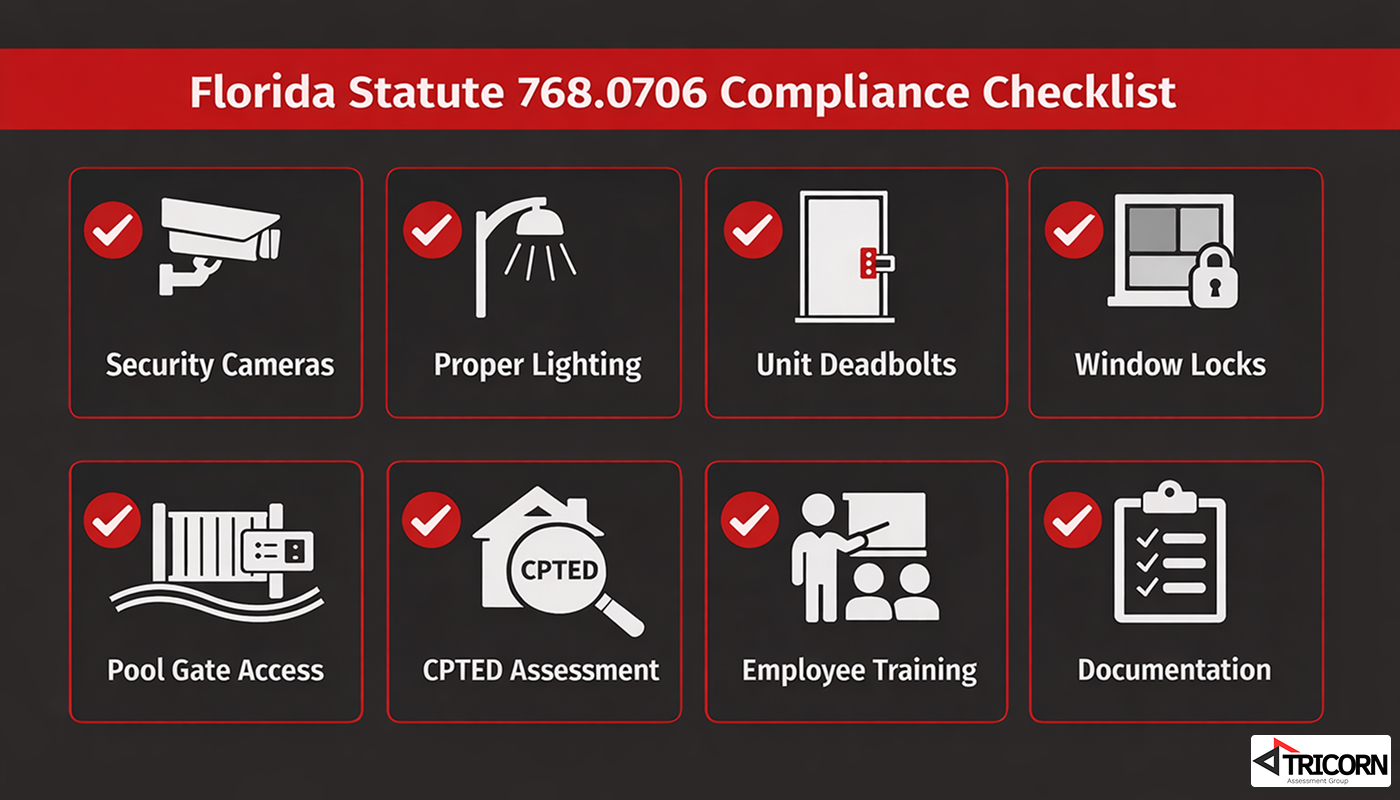
Florida Statute 768.0706 Compliance Checklist
Use the checklist below as a starting point for reviewing your property and documenting the status of each requirement.
1. Security Cameras at Entry and Exit Points
Confirm that the property has a security camera system installed at points of entry and exit and that footage can be retrieved when needed. The statute specifically requires video footage to be maintained as retrievable for at least 30 days.
Checklist:
- Cameras are installed at property entry points
- Cameras are installed at property exit points
- Video footage is retained for at least 30 days
- Camera views are usable and not blocked
- Recording equipment is functioning properly
- Management can retrieve footage when needed
Common issue: Some properties have cameras installed, but coverage is incomplete, retention settings are too short, or image quality is too poor to be useful during an investigation.
2. Lighting in Required Areas
Review lighting conditions across the property, especially in parking areas and pedestrian spaces. The statute requires a lighted parking lot with an average of at least 1.8 foot-candles at 18 inches above the surface, along with lighting in walkways, laundry rooms, common areas, and porches from dusk to dawn or by photocell or similar electronic control.
Checklist:
- Parking lot lighting provides adequate illumination
- Walkways are illuminated
- Common areas are illuminated
- Laundry rooms are illuminated where applicable
- Building porches and similar areas are illuminated
- Lighting operates from dusk to dawn or by photocell or similar controls
- Burned-out fixtures are replaced promptly
If lighting conditions are uneven, poorly maintained, or too dim in critical areas, a more detailed review may be needed. In those situations, a dedicated security lighting assessment can help document deficiencies and identify corrective measures.
3. Residential Unit Door Hardware
Check whether residential units meet the statute's physical security requirements. Florida Statute 768.0706 requires at least a 1-inch deadbolt on each dwelling unit door and either a peephole or door viewer.
Checklist:
- Each dwelling unit has a 1-inch deadbolt lock
- Each unit entry door has a peephole or door viewer
- Unit doors are in good condition and function properly
- Damaged locks or hardware are repaired promptly
Common issue: A property may meet the requirement in many units but still have gaps caused by deferred maintenance, damaged hardware, or inconsistent upgrades across buildings.
4. Window and Sliding Door Locking Devices
Review locking devices for windows and sliding doors in residential units. The statute requires locking devices on windows, exterior sliding doors, and any other doors that are not used for community purposes.
Checklist:
- All windows have functioning locking devices
- Exterior sliding doors have functioning locking devices
- Locking hardware is consistent across units
- Missing or damaged hardware is replaced
This is one of the easiest areas to overlook during routine operations, especially at older properties with multiple phases or inconsistent renovation history.
5. Pool Gate Access Control
If the property has a pool, review gate security and access control measures. The statute requires a locked gate with key or key fob access, pool safety gates that are self-closing and self-latching, or a lifeguard on duty during operating hours.
Checklist:
- Pool gates are locked
- Pool access is controlled
- Gate hardware is functional
- Access credentials are properly managed
- Gates close and latch correctly
Common issue: Pool gates may technically exist but fail to latch, remain propped open, or rely on outdated hardware that does not provide reliable access control.
6. CPTED Assessment Requirement
By January 1, 2025, qualifying properties were required to have a CPTED assessment completed and documented. The assessment must be no more than three years old, and the property must remain in substantial compliance with the assessment considerations to support the statute's presumption. The statute requires that the assessment be completed by a law enforcement agency or a Florida CPTED practitioner designated by FCPTI.
Checklist:
- The property has a current CPTED assessment
- The assessment was completed by a qualified provider
- The assessment is properly documented
- Management has reviewed the findings
- Considerations have been addressed or scheduled
- Compliance status is tracked over time
For many properties, this is the most important part of the compliance process because it helps identify site-specific vulnerabilities involving visibility, access control, lighting, layout, and maintenance. Properties that need this type of review can learn more about CPTED assessments and how they apply to multifamily communities.
7. Employee Crime Deterrence and Safety Training
The statute also requires crime deterrence and safety training for current employees and for new employees within 60 days after hire. The Florida Senate bill materials describe this training requirement as part of the conditions supporting the presumption against liability.
Checklist:
- Current employees have received training
- New employees receive training within the required timeframe
- Training covers relevant crime deterrence and safety procedures
- Training records are maintained
- Training content is reviewed and updated as needed
This requirement should not be treated as a one-time item. Training should reflect the property's actual security conditions, procedures, and recurring issues.
8. Ongoing Maintenance and Documentation
A checklist alone is not enough if the property cannot show what was reviewed, repaired, or implemented. The Florida Senate bill analysis explains that the statute was designed to create a presumption when owners install and maintain the specified measures. That makes documentation especially important for inspections, repairs, training records, and follow-up on assessment considerations.
Checklist:
- Maintenance records are organized
- Lighting repairs are documented
- Camera issues and repairs are documented
- Lock and hardware replacements are documented
- CPTED reports and follow-up actions are preserved
- Employee training records are maintained
- Property staff know who is responsible for tracking compliance items
Documentation helps show that a property is actively reviewing and maintaining relevant security conditions rather than relying on outdated assumptions.
Why a Checklist Alone Is Not Enough
A checklist is useful, but it does not replace a property-specific review. Many apartment communities have some security features in place without knowing whether those features actually meet the statute's practical requirements. Others have partial compliance in some buildings or common areas but overlooked deficiencies in others. The CPTED requirement is especially important because the statute does not simply ask whether a property has equipment. It also expects a current assessment and substantial compliance with the considerations.
That is why many owners and operators use formal assessments to review lighting performance, camera placement, access control conditions, visibility and concealment issues, maintenance deficiencies, and property-specific risk factors. For properties operating in different parts of Florida, it can also help to review the locations where these services are available or contact us to discuss a compliance review.
When Property Owners Should Take Action
Property owners and managers should consider a formal compliance review when:
- The property has not completed a CPTED assessment
- The existing assessment is more than three years old
- Management is unsure whether all required measures are in place
- Lighting, hardware, or camera systems have known deficiencies
- There has been recent turnover in ownership or management
- The property is preparing for insurance, legal, or operational review
Taking action before an issue becomes part of a claim is usually more effective than trying to reconstruct compliance efforts later.
Final Thoughts
Florida Statute 768.0706 has made apartment complex security compliance a practical risk-management issue for property owners and managers. Cameras, lighting, locks, pool gate controls, employee training, and CPTED assessments all play a role in whether a property can demonstrate substantial implementation of the required measures. HB 837 created the framework, and the statute lays out the specific items that should be reviewed and documented.
A checklist is a useful first step, but most properties benefit from a more detailed review of actual site conditions. For owners and operators evaluating next steps, the most effective approach is usually to review the statutory requirements, identify gaps, and prioritize corrective action before those issues become larger operational or legal problems.
Property owners and managers who need help reviewing lighting, access control, CPTED requirements, or overall Florida Statute 768.0706 compliance can contact us to discuss next steps or request an assessment.
Request a CPTED assessment quote
Tell us about your property and you'll receive scope, timeline, and a fixed quote within one business day. No obligation.
Why Property managers choose Tricorn
Prefer to reach us directly