The Impact of Florida's HB 837 on Property Security and Liability
August 27, 2025
Why Florida HB 837 Fundamentally Changed Property Liability
Florida HB 837 represents the most significant tort reform in decades, fundamentally reshaping how property owners face liability claims. Signed into law by Governor Ron DeSantis on March 24, 2023, this legislation was designed to curb frivolous lawsuits and reduce predatory practices targeting property owners.
Key Changes Under Florida HB 837:
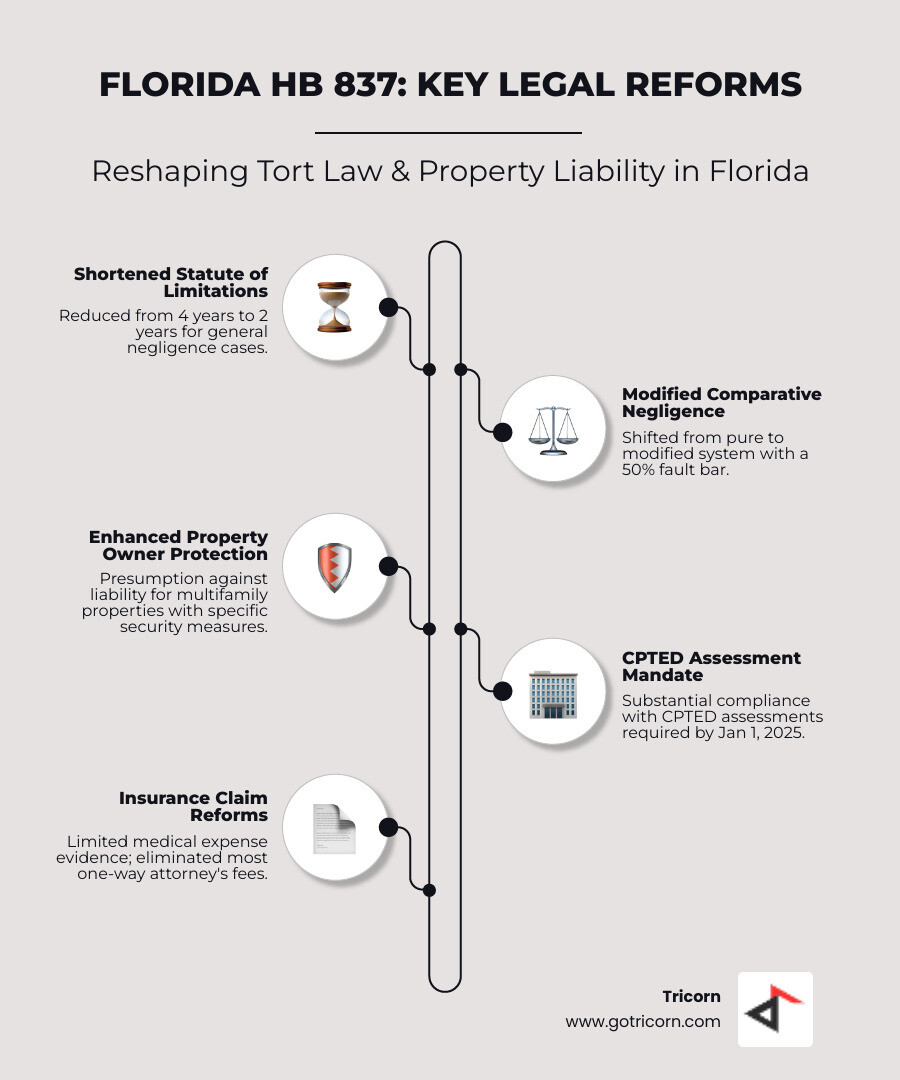
- Statute of Limitations: Reduced from 4 years to 2 years for general negligence cases
- Comparative Negligence: Shifted from pure to modified system (50% fault bar)
- Property Owner Protection: Created presumption against liability for multifamily properties with specific security measures
- CPTED Requirement: Mandates substantial compliance with Crime Prevention Through Environmental Design assessments
The law took effect immediately upon signing, with different provisions applying to causes of action filed or accruing after March 24, 2023.
For multifamily property owners, HB 837 offers significant liability protection, but only if you meet seven specific security requirements and achieve substantial compliance with a CPTED assessment. The reform shifts the legal landscape by creating a presumption against liability for owners or principal operators of multifamily residential property that substantially implements specified security measures, in connection with certain criminal acts that occur on the premises.
Sweeping Changes to Negligence and Liability in Florida
Florida HB 837 completely rewrote how civil lawsuits work in the state. These changes reach beyond property law, affecting anyone involved in negligence cases.
Shortened Statute of Limitations for Negligence
The law reduced the statute of limitations for general negligence cases from four years to two years. This applies to anyone injured after March 24, 2023. Whether you slipped on a wet floor, got hurt in a car accident, or suffered injuries due to someone else's negligence, you now have half the time to take legal action.
Evidence disappears, witnesses forget details, and security camera footage gets deleted. The shorter timeline pushes everyone to act faster, which can lead to stronger cases with fresher evidence.
Wrongful death and medical malpractice cases keep their original timelines. The legislature recognized these cases often take longer to discover and investigate, so they carved out exceptions.
Shift to Modified Comparative Negligence
This is the largest change in Florida HB 837. Florida used to follow "pure comparative negligence." Under that system, even if you were 90% responsible for your own accident, you could still recover 10% of your damages.
That is no longer the case. Florida now follows a modified comparative negligence standard with a 50% fault bar. If a jury finds the plaintiff more than 50% at fault, the plaintiff's recovery is entirely barred.
For property owners, the law now allows juries to assign fault to criminals in negligent security cases. If someone gets robbed in a parking lot, the jury can consider how much fault belongs to the actual criminal versus the property owner. Property owners are no longer automatically held solely responsible for the financial consequences of third-party criminal acts on their premises.
New Rules for Litigation and Insurance Claims
Florida HB 837 also addressed how lawsuits work when it comes to medical bills and insurance disputes.
Medical expenses received a major overhaul. Plaintiffs can now only present what was actually paid for medical services, not the full billed amount. If a surgery bill was $50,000 but insurance negotiated it down to $15,000, the jury only sees the $15,000 figure.
For unpaid medical bills covered by letters of protection, the law sets strict caps. Medical services with Medicare rates are capped at 120% of that rate. Services with Medicaid rates but no Medicare rate are capped at 170% of Medicaid. Everything else is limited to 120% of what similar services actually cost in the area over the past three years.
The law also requires more transparency about medical referrals. If an attorney referred a plaintiff to a doctor, that relationship must be disclosed in court.
Insurance bad faith cases are now more difficult to pursue. Insurance companies receive a 90-day cure period after notification of a problem. Simple negligence by an insurance company can no longer form the basis of a bad faith claim.
Florida HB 837 also eliminated one-way attorney's fees in most insurance cases. Previously, if a policyholder prevailed against their insurance company in court, the insurer paid the policyholder's legal costs. That is no longer the case.
Understanding Florida HB 837's Impact on Multifamily Properties
If you own or operate a multifamily residential property in Florida, Florida HB 837 provides real protection against negligent security lawsuits. But the protection must be earned.
The law creates a presumption against liability for properties that meet specific security requirements. This presumption shifts the burden of proof. Instead of the property owner having to prove they did everything right, the plaintiff must prove the property owner failed to meet the statutory standard. That is a significantly more difficult burden for a plaintiff to carry.
This protection is codified in Florida Statute 768.0706 and applies to any building or group of buildings with at least five dwelling units on a particular parcel. The requirements are specific, and meeting them requires a qualified practitioner to evaluate the property and provide considerations for improvement.
List of Specific Security Measures for Liability Protection
Security camera system at each entrance and exit, retaining video for at least 30 days. Every access point needs coverage, and footage must be retained long enough for law enforcement to use it.
Adequate lighting in parking lots, walkways, laundry rooms, and common areas. For parking lots, the requirement is specific: illumination to a minimum of 1.8 foot-candles, measured at a height of 18 inches, from dusk to dawn. Tricorn provides security lighting assessments that document whether your property meets these requirements with photometric measurements.
A 1-inch deadbolt on every dwelling unit door. Standard spring-latch locks do not satisfy this requirement. The law specifically calls out the one-inch measurement because shorter deadbolts are easier to defeat.
Locking devices on every window and exterior sliding door. This includes ground-floor windows, sliding patio doors, and any other openings that could provide access.
A peephole or door viewer on each dwelling unit door. In addition, pool gates must remain in a locked state with controlled access.
Crime deterrence and safety training for all property staff. This goes beyond basic customer service training. Tricorn provides crime deterrence training for properties that have completed a CPTED assessment, covering security awareness, CPTED principles, and the specific considerations identified in the property's assessment report. Current employees must be trained, and new employees must complete training within 60 days of hire.
Substantial compliance with a CPTED assessment. This is the most important requirement. Getting the assessment done is not enough. The property must actually implement the key considerations identified by the assessor. The assessment must be conducted by a certified Florida CPTED Practitioner (FCP) or a law enforcement agency, and it must be renewed every three years.
These seven measures work together to create layers of security that deter crime and protect residents.
The Critical Role of CPTED Assessments for Florida HB 837
Of all the security measures required by Florida HB 837, the CPTED assessment requirement is both the most important and the most misunderstood. CPTED stands for Crime Prevention Through Environmental Design, and it is a comprehensive approach to making a property inherently safer through design and management. You can learn more about the methodology at What is CPTED?.
CPTED works on the principle that the physical environment can be designed and managed to reduce crime opportunities. It focuses on four core strategies: natural surveillance (can people see what is happening?), natural access control (are people guided where they should go?), territorial reinforcement (does the space feel owned and cared for?), and maintenance and management (are problems being addressed consistently?).
What makes CPTED different from traditional security approaches is the focus on environmental conditions rather than hardware alone. Instead of adding more locks and cameras, CPTED evaluates how criminals think and behave, then uses design to make crime less likely in the first place. A CPTED assessment might identify overgrown landscaping blocking sightlines, inadequate lighting creating concealment opportunities, or traffic flow patterns that reduce natural surveillance.
Florida HB 837 requires that your CPTED assessment be conducted by a certified Florida CPTED Practitioner (FCP) or a law enforcement agency. The property must then achieve "substantial compliance" with the assessment's considerations. Substantial compliance does not mean implementing every single consideration. It means addressing the major security vulnerabilities identified in the assessment. Prioritizing improvements that provide the most significant safety impact for the available budget is a practical approach that courts have recognized.
The assessment is property-specific. What works for a garden-style complex in Orlando will not necessarily apply to a high-rise in Miami. A proper CPTED assessment examines the specific property layout, surrounding neighborhood, local crime patterns, and resident demographics to develop considerations tailored to the property's actual conditions.
For a deeper analysis of how CPTED assessments factor into negligent security litigation, read How CPTED Assessments Affect Negligent Security Litigation in Florida.
For attorneys and risk managers involved in premises liability cases, Tricorn provides FCP-certified expert witness services reviewing property security conditions, lighting standards, and CPTED compliance.
Frequently Asked Questions about Florida HB 837
What is the effective date of HB 837 and how does it apply?
Florida HB 837 became law when Governor Ron DeSantis signed it on March 24, 2023. Most provisions apply to incidents that occur after that date. The shortened two-year statute of limitations applies to any negligence case filed after the effective date, regardless of when the incident occurred.
The timing rules can be complex. Consulting with a qualified attorney about a specific situation is always recommended.
How does HB 837 protect businesses and property owners?
Florida HB 837 creates several layers of protection that work together.
The presumption against liability for multifamily properties is the most powerful. When you implement all seven security measures and achieve substantial compliance with a CPTED assessment, the law presumes you were not negligent if a crime happens on your property. The injured party must prove you failed to meet the statutory standard rather than you having to prove you met it.
The modified comparative negligence rules add further protection. If a plaintiff is more than 50% at fault, they recover nothing. In negligent security cases, juries can now assign fault to the criminal actor, which means property owners are not automatically held solely responsible for third-party criminal acts.
Medical expense limitations prevent inflated damage claims. Plaintiffs can only present what was actually paid for medical treatment, not the full billed amount.
These protections work best when property owners are proactive about security. The law rewards those who take documented, reasonable steps to keep residents safe.
What does 'substantial compliance' with a CPTED assessment mean?
Substantial compliance means making a documented, good-faith effort to implement the most important considerations from your CPTED assessment. It does not require perfection. Budget constraints, building limitations, and other practical factors are recognized realities.
The focus should be on high-impact improvements that genuinely improve safety. If the assessment identifies inadequate parking lot lighting, addressing that lighting should take priority over cosmetic changes. If overgrown landscaping creates concealment opportunities, trimming that vegetation matters more than installing decorative security features.
Documentation is critical. Keep detailed records showing what your CPTED assessment identified, what steps you took to address those considerations, and the reasoning behind your decisions. If a negligent security claim is filed, this documentation supports your defense.
Substantial compliance is also an ongoing commitment. The initial assessment establishes a baseline, but maintaining a secure property requires continued attention. Broken lights need to be replaced, landscaping needs to be maintained, and security systems need to remain functional. The assessment must be renewed every three years, and the property must remain in substantial compliance throughout that period.
Secure Your Property and Reduce Liability Exposure
Florida HB 837 created a clear path for multifamily property owners: implement the required security measures, achieve substantial compliance with a CPTED assessment, and gain the presumption against liability in negligent security claims.
The seven security requirements are specific and verifiable. The CPTED assessment provides the framework for identifying and addressing environmental conditions that affect crime risk. Together, they form a documented defense that holds up in court.
Tricorn Assessment Group provides FCP-certified CPTED assessments for multifamily and commercial properties across Florida. Each assessment evaluates lighting, camera coverage, physical hardware, landscaping, and site design against the requirements of Florida Statute 768.0706 and established CPTED standards.
To discuss an assessment for your property, contact Tricorn.
Request a CPTED assessment quote
Tell us about your property and you'll receive scope, timeline, and a fixed quote within one business day. No obligation.
Why Property managers choose Tricorn
Prefer to reach us directly