
HOA & Community Association Security Assessments
FCP certified CPTED assessments that document substantial compliance with Florida Statute 768 0706, reduce board liability exposure, and produce the security documentation your insurance carrier and legal counsel expect.
Does Florida Statute 768.0706 apply to HOAs?
Florida Statute 768.0706 was written for "multifamily residential property," which the statute defines broadly enough to include many condominium associations, townhome communities, and planned residential developments, in addition to traditional apartment complexes.
Whether a specific HOA or community association falls within the statute depends on the community's structure, ownership model, and the specific common areas under association control. Gated communities with shared pools, clubhouses, mail rooms, and amenity buildings almost always have facilities the statute addresses directly.
Even where 768 0706 does not apply strictly, the security measures it requires (lighting, access control, CPTED assessment, employee training) reflect the standard of care Florida courts apply in negligent security cases against community associations. Operating below that standard exposes both the association and the individual board members who approved the security posture.
Why HOA boards commission CPTED assessments
HOA boards request CPTED assessments for four reasons, often at once.
01
Reduce Board Liability Exposure
Board members owe a fiduciary duty to homeowners and face personal liability for decisions about community safety. A documented CPTED assessment is evidence of due diligence that protects individual directors and officers in premises liability and breach-of-duty claims.
02
Support Insurance Renewals
Florida insurance carriers are increasingly asking whether associations have completed 768 0706 compliance assessments. A current CPTED report supports favorable renewal terms on general liability and D&O coverage, and can prevent non-renewal or coverage reductions after an incident.
03
Document Common Area Security
HOA common areas including pools, clubhouses, gyms, mail rooms, gates, and shared parking are the highest-risk zones in most communities. A CPTED assessment documents the security conditions of each common area and produces a compliance baseline that survives future board turnover.
04
Resolve Homeowner Concerns
After an incident or a wave of homeowner complaints about security, boards face pressure to act. A professional CPTED assessment replaces reactive decisions with a documented, defensible security plan the board can present at the next annual meeting.
Protect Your Board. Document Your Community's Compliance.
FCP certified CPTED assessments for Florida HOAs and community associations. Request a scoping call to discuss your community's 768 0706 compliance status.
What we assess at HOA and association properties
Every HOA CPTED assessment is conducted by a Florida Crime Prevention Through Environmental Design Practitioner (FCP) designated by the Florida Crime Prevention Training Institute. The assessment covers each common area under association control and the perimeter conditions between the community and adjacent public space.
Community Entry and Perimeter
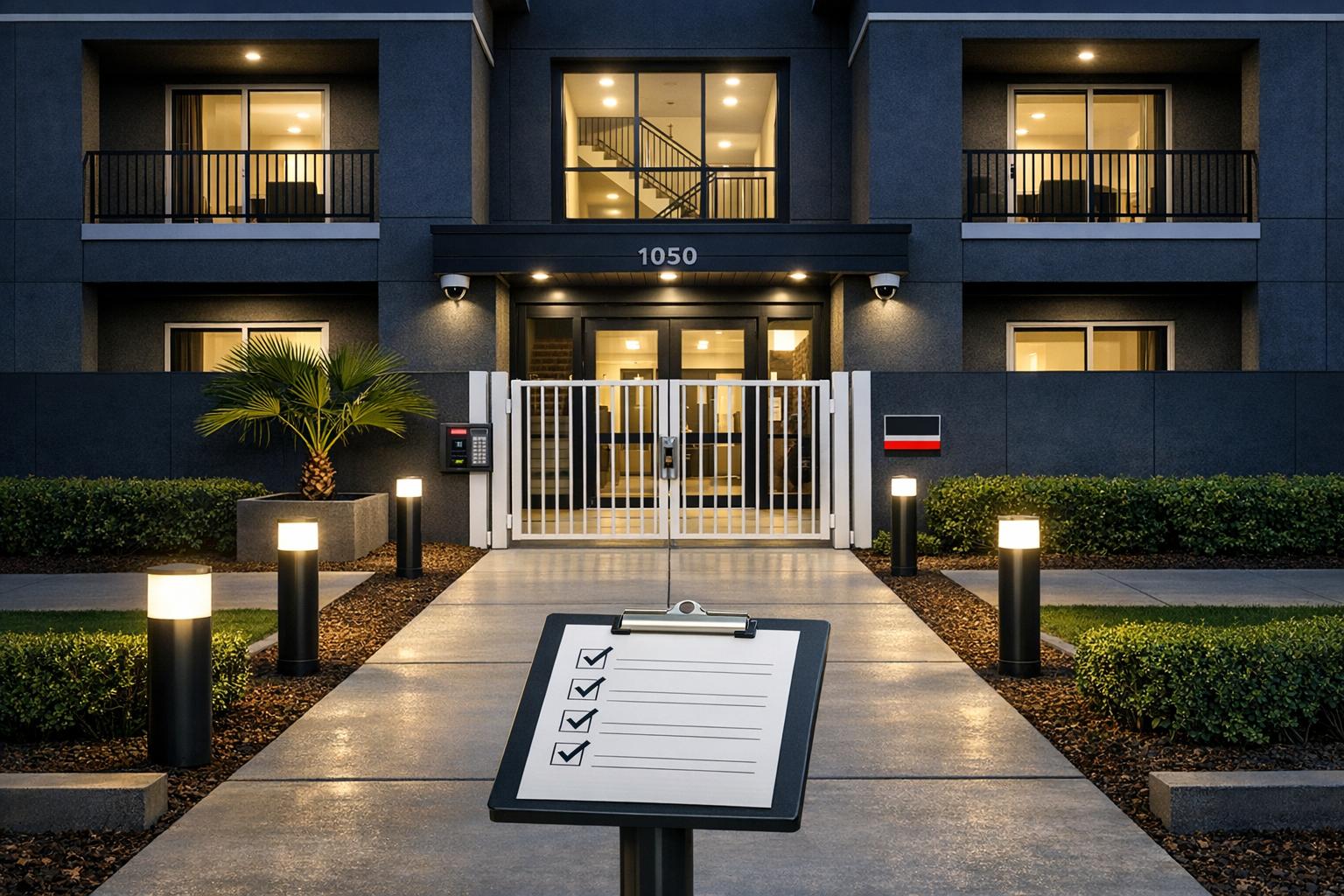
Vehicular gates, pedestrian access points, perimeter fencing, signage defining private property, and transition zones between public and private space.
Pool, Clubhouse, and Amenity Areas
Pool gate compliance under 768 0706, key fob and access control systems, CCTV coverage, nighttime lighting, and visibility conditions at clubhouses, gyms, and shared amenity buildings.
Design elements such as pathways, transition areas, and wayfinding help direct movement across the property.
Common Area Lighting
Illumination levels and foot-candle measurements across parking areas, sidewalks, mail rooms, amenity entrances, and walkways between buildings. Dusk to dawn functionality and shadow area identification.
Lighting, signage, and clearly defined entrances help reinforce property boundaries.
Mail and Package Areas
Security conditions at centralized mail and package facilities, including visibility, access control, and camera coverage. Package theft is one of the most common reported incidents in Florida HOAs.
Consistent maintenance helps support long term safety and reinforces the other CPTED principles.
Landscaping and Sightlines
Vegetation that obscures windows, entrances, and pathways. Territorial definition between common and private lots. Wayfinding and signage supporting natural surveillance.
Deliverables for HOA boards
The final report is structured for three audiences: the board itself, the association's insurance carrier, and if necessary, legal counsel.
What the board receives:
A written report documenting observations, photographs of each common area, compliance status against Florida Statute 768 0706, and a prioritized list of recommended improvements with rough cost categorization. The report is delivered digitally and reviewed in a walk-through meeting with the board.
What the insurance carrier receives (through the board):
Florida insurance carriers are increasingly asking whether associations have completed 768 0706 compliance assessments. A current CPTED report supports favorable renewal terms on general liability and D&O coverage, and can prevent non-renewal or coverage reductions after an incident.
What the board can use at the annual meeting:
A one-page homeowner-facing summary describing the assessment scope, findings categories, and the board's action plan, suitable for distribution at annual meetings or inclusion in association newsletters.
Our process for HOA and association assessments
Scope Call with Board
A 30 to 45 minute call with the board president, property manager, or association attorney to confirm scope, identify the common areas to be assessed, and review any recent incidents or homeowner concerns that should inform the evaluation.
On-Site CPTED Assessment
Our FCP certified practitioner conducts a daytime walkthrough of all association common areas followed by a nighttime lighting and visibility evaluation. Typical HOA assessments require one or two site days depending on community size.
Written Report and Board Review
You receive a digital report with documented findings, photographs, compliance status against 768 0706, and prioritized considerations. Our practitioner walks the board through the findings in a review meeting.
Annual Reassessment Planning
Florida Statute 768 0706 requires the CPTED assessment to be no more than three years old. We schedule a reminder and can provide updated assessments after community renovations, amenity additions, or a change in security conditions.
Who is qualified to perform the CPTED assessment?
Every Tricorn CPTED assessment is conducted by a Florida Crime Prevention Through Environmental Design Practitioner (FCP) designated by the Florida Crime Prevention Training Institute.
The FCP credential is the qualification required under Florida Statute 768 0706 for multifamily properties seeking the presumption against liability. Outside Florida, it signals that your assessment is being performed by a practitioner trained to national CPTED standards rather than a general security consultant or facilities inspector. This distinction matters in litigation. Assessments conducted by unqualified parties are routinely challenged by opposing counsel in premises liability cases. A report authored by a credentialed practitioner carries weight that a generic security audit does not.
Every Tricorn assessment is conducted by an FCP-certified practitioner with real-world security and operational experience. Our team includes Mario deGraaf (FCP, CPD) with 17+ years military intelligence experience and hundreds of completed assessments, Kyle Scroggins (FCP) with 14+ years in multifamily security, Robert Gaskell (FCP), a U.S. Air Force veteran with 100+ assessments completed, and Seth Ryan (FCP), a U.S. Army Special Operations Ranger and former law enforcement officer. Meet the full team.
Who retains Tricorn for HOA work
HOA Boards and Association Directors
Directly engage Tricorn to document community security conditions, support insurance renewals, and reduce personal board liability exposure.
Community Association Managers (CAM)
CAMs and management companies retain Tricorn to complete 768 0706 compliance work across portfolios of managed associations and document security conditions for board review.
Association Counsel
HOA legal counsel retains Tricorn for pre-litigation assessments, expert analysis in premises liability matters, and compliance documentation supporting board defense.
Request an HOA security assessment quote
Tell us about your community and we'll provide a scope, timeline, and fixed quote within one business day. No obligation.
Why Property managers choose Tricorn
Prefer to reach us directly
Frequently Asked Questions
The statute applies to multifamily residential property, which can include many condominium associations, townhome communities, and planned residential developments. Whether 768 0706 applies to a specific association depends on the community's ownership structure and the common areas under association control. Even where the statute does not apply strictly, the security measures it requires reflect the standard of care Florida courts apply to community associations in negligent security cases.
A documented CPTED assessment is evidence that the board exercised reasonable due diligence in addressing community security. It does not eliminate personal liability, but it supports the director and officer defense that the board acted reasonably and in good faith based on professional analysis. Boards that cannot demonstrate a documented security review are more exposed in breach-of-duty and premises liability claims.
House Bill 837 is the 2023 Florida tort reform legislation that created Florida Statute 768 0706. Where the statute applies, HB 837 establishes the framework under which multifamily residential properties, including many HOAs and condominium associations, can qualify for a presumption against liability in negligent security cases by substantially complying with specified security measures.
Most HOA assessments require one or two site days, depending on the number of common areas and the size of the community. Each assessment includes a daytime walkthrough, a nighttime lighting evaluation, and a follow-up board review meeting. The written report is typically delivered within one week of the on-site visit.
Florida Statute 768 0706 requires the CPTED assessment to be no more than three years old. We recommend updating the assessment earlier if the community completes significant renovations, adds amenities, or experiences a change in security conditions that could affect the compliance baseline.
Yes. Tricorn provides crime deterrence and safety training at no additional charge to clients for whom a property assessment has been completed. HB 837 requires property owners to provide crime deterrence training to current employees and to all new employees within 60 days of hire. This training requirement is included as part of Tricorn's assessment service.
Yes. Every HOA assessment produces a compliance documentation summary formatted for carrier review. The summary confirms the association has completed a current CPTED assessment by an FCP certified practitioner and identifies the community's compliance status relative to Florida Statute 768 0706.



.webp)